EMAIL US
Anna04@pandadiesel.com Liza03@pandadiesel.com

In 2026, diesel workshops and remanufacturing lines are dealing with a more complex injector mix than ever before — Bosch, Denso, and Cummins families running side by side, solenoid and piezo variants on the same bench, and customers expecting rebuilt injectors to perform at factory specification. The pressure is real: fleet operators and OEM service networks are tracking comeback rates, and a single batch of inconsistent rebuilds can cost a workshop more in rework and reputation than the original job was worth.
The root cause of most comeback events is not parts quality — it is process quality. Many rebuilders still rely on semi-manual methods where the final assembly outcome depends on individual technician feel rather than measured verification. The fix is a shift from mechanic rebuild to process-controlled remanufacturing, using professional common rail injector repair tools to measure critical clearances and strokes, select shims to a calculated target, and verify the mechanical stack before the injector ever reaches the test bench.
This article explains how Stage-3 tooling standardizes that process, what specifications belong in a professional kit, and how to calculate the ROI of moving from inconsistent manual rebuilds to a repeatable, measurable workflow.
Most diesel workshops understand Stage 1 and Stage 2 of injector overhaul — disassembly and parts replacement. The injector comes apart, worn components are identified, and new parts go in. What separates a professional remanufacturing operation from a basic repair shop is what happens next: Stage 3.
Stage 3 is the final measurement and adjustment step that occurs after parts replacement and before bench testing. It is where the rebuilt injector's internal stack — the combination of springs, shims, valve elements, and needle components — is measured, compared against the target specification, and adjusted by selecting the correct shim thickness to achieve the designed lift and clearance values.
This step is where manual rebuilds most commonly fail. A technician who assembles by feel rather than measurement may produce an injector that passes a quick bench test at nominal conditions but drifts outside specification under load, temperature variation, or extended duty. The result is a comeback — often weeks after delivery, when the customer has already lost confidence in the workshop.
The common rail fuel injection system relies on micron-level precision in the injector's internal geometry. The solenoid valve or piezo actuator controls needle lift through a mechanical stack whose dimensions are set during assembly. A shim that is 10 microns too thick or too thin changes the valve opening pressure, the needle lift, and ultimately the fuel quantity delivered per injection event. At idle, this shows up as rough running. Under load, it shows up as smoke, power loss, or fault codes.
Stage-3 tooling converts that precision requirement from a technician skill into a documented process step. Measure, select, verify, lock in. Every injector, every technician, every time.
The working principle of Stage-3 measurement is straightforward once the internal architecture of a common rail injector is understood. The common rail injector repair tools' performance is determined by a mechanical stack — a series of components whose combined height sets the valve opening characteristics and needle travel. If the stack height is correct, the injector delivers the designed fuel quantity at the designed injection pressure. If it is not, the injector is out of specification before it leaves the bench.
After parts replacement, the actual stack height will differ from the original because new components have dimensional tolerances. The shim — a precision-ground spacer inserted at a defined location in the stack — is the adjustment element that compensates for these tolerances and brings the assembled stack back to the target dimension.
The Stage-3 process follows a consistent sequence:
Measure the actual dimensions of the assembled components using a calibrated measurement tool. Compare the measured stack height against the target specification for that injector family. Calculate the required shim thickness to close the gap between actual and target. Select the correct shim from the available range. Reassemble with the selected shim and re-verify the stack height before proceeding to bench testing.
This process requires two things that manual assembly cannot provide: a measurement tool with sufficient resolution to detect the relevant dimensional variation, and a shim range with sufficient thickness steps to hit the target within the required tolerance.
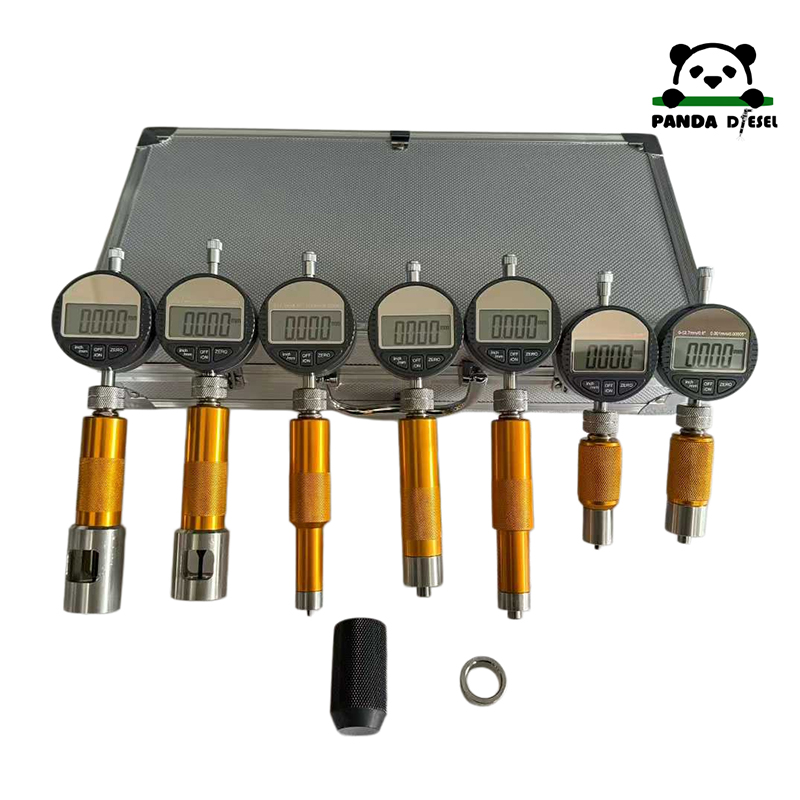
Panda Diesel's tool range addresses both requirements. The measurement tools and stroke verification tools in the kit are designed to capture the critical dimensions at each stage of the assembly process. The CR052 pneumatic shims tester — with a testing range of 15mm — provides the verification step that confirms shim selection before final assembly. The result is that the bench test validates a mechanically correct injector rather than discovering a mechanically incorrect one.
The messaging implication for workshop owners is direct: your bench test is only as repeatable as your pre-test mechanical calibration. A test bench can measure what an injector delivers. It cannot correct what was assembled incorrectly.
A professional Stage-3 toolkit is not a single tool — it is a system of measurement, brand-specific handling, and safety verification tools that work together to cover the full rebuild workflow. The following checklist covers the categories that a complete kit should address.
| Tool | Function | Role in Stage-3 Workflow |
|---|---|---|
| Full common rail tool set (CR001) | Core disassembly and assembly toolkit | Process backbone for all injector families |
| Injector valve measuring tool (CR016A) | Measures valve and armature dimensions | Critical for stack height calculation |
| Support stand (CR029B) | Holds injector during measurement and assembly | Prevents handling damage; ensures consistent orientation |
| Shims tester (CR052) | Pneumatic verification of shim thickness; 15mm range | Confirms shim selection before final assembly |
| Stroke and lift tools | Verifies needle travel and valve lift | Confirms mechanical calibration against specification |
| Chamber resurfacing tool (DS009A) | Resurfaces internal valve seat | Restores sealing geometry after wear |
| Kit | Application | Value |
|---|---|---|
| Bosch CRIN4 kit (BS016C) | Bosch CRIN4 solenoid injectors | Prevents damage to CRIN4-specific components; speeds changeover |
| Denso G4 kit (DS022) | Denso G4 injector family | Correct fixtures for G4 geometry; reduces trial-and-error |
| Cummins XPI/HPI X15 kit (KM011/KM027) | Cummins XPI and HPI X15 series | Covers the dimensional requirements specific to Cummins architecture |
Brand-specific kits matter because using generic tools on injectors with family-specific geometries is a common source of component damage during disassembly and reassembly. A damaged nozzle nut or a scratched valve seat turns a repairable injector into scrap. The kit cost is recovered on the first avoided scrap event.
| Tool | Specification | Function |
|---|---|---|
| High-pressure tube leak testing tool (CR068C) | 260 MPa rated | Verifies connection integrity before pressurization |
| Anti-fog viewing accessory (CR060A) | — | Maintains visibility during high-pressure testing |
| Pneumatic puller tools | — | Safe removal of stuck components without damage |
| Nozzle nut tools | — | Correct torque application without thread damage |
The 260 MPa leak testing rating on the CR068C is not a marketing specification — it reflects the actual operating pressures of modern common rail systems, where rail pressures above 200 MPa are standard in current-generation engines. A leak test tool rated below system pressure is not a safety tool.
A workshop that currently handles injector repairs occasionally — one or two per week, different brands, different technicians — is the highest-ROI candidate for Stage-3 tooling. The inconsistency in that environment is not a technician problem; it is a process problem. Introducing measurement-based assembly with professional diesel tool kits converts an unpredictable outcome into a repeatable one, regardless of which technician performs the rebuild.
For shops serving fleet operators, construction equipment dealers, or agricultural equipment networks, the comeback rate is a direct business metric. A reduction from 15% comebacks to 3% comebacks on a volume of 10 injectors per week is 1.2 fewer rework events per week — each of which carries labor cost, parts cost, and customer relationship cost.
Production reman lines face a different version of the same problem: consistency across batches and across technicians. When a line produces 50 injectors per day, a 5% variation in shim selection accuracy produces 2 to 3 injectors per day that will underperform or fail at the customer. Stage-3 tooling with documented measurement records per injector serial number provides the process control that reduces that variation and supports the quality documentation that OEM and fleet customers increasingly require.
Workshops servicing Bosch, Denso, and Cummins injectors on the same bench face the additional challenge of managing brand-specific tooling requirements without cross-contamination of fixtures or procedures. Brand-specific kits from Panda Diesel — covering CRIN4, Denso G4, and Cummins XPI/HPI families — allow technicians to work on each family with the correct tools without improvising, which is the most common source of component damage in mixed-brand environments.
Stage-3 tooling does not require a facility rebuild. The primary setup requirement is a dedicated clean measurement area — a bench section reserved for measurement, shim selection, and precision assembly, separated from the disassembly and cleaning area to prevent contamination of measuring faces and shim surfaces.
Air supply is required for pneumatic tools including the CR052 shims tester. Standard shop air at 6 to 8 bar is sufficient for most pneumatic fixtures. A torque wrench calibrated to the injector family specifications is required for final assembly.
The most important setup element is procedural: a measurement record sheet per injector that captures the measured dimensions, the calculated shim requirement, the selected shim thickness, and the verification measurement after assembly. This record is the audit trail that supports warranty claims, customer documentation, and internal quality review.
| Step | What to Define | Why It Matters |
|---|---|---|
| Injector families serviced | Bosch CRIN4, Denso G4, Cummins XPI/HPI, others | Determines which brand-specific kits are required |
| Required measurement steps | Valve measurement, shim thickness verification, stroke/lift checks | Determines which core measurement tools are needed |
| Safety and leak testing requirement | High-pressure tube testing, connection verification | Determines whether CR068C and associated safety tools are needed |
| Volume and throughput | Injectors per week, number of technicians and bays | Determines whether multiple sets of core tools are needed for parallel bays |
| Current failure modes | Comebacks, bench failures, component damage during disassembly | Identifies which tool gaps are causing the most cost |
| Cost / Benefit Item | What to Measure |
|---|---|
| Rework labor cost avoided | Comeback rate reduction × average rework labor hours × labor rate |
| Parts scrap cost avoided | Component damage rate reduction × average scrap value per injector |
| Bench retest time avoided | False-pass rate reduction × bench time per retest × bay cost per hour |
| Lost bay time avoided | Comeback handling time × bay opportunity cost per hour |
| Tool kit amortization | Kit purchase price ÷ expected service life in years |
| Training time cost | Hours to train technicians on Stage-3 procedure × labor rate |
| Net annual benefit | Sum of avoided costs minus tool amortization and training |
| Payback period | Tool kit cost ÷ net annual benefit |
For a workshop handling 20 injectors per week with a 12% comeback rate, reducing comebacks to 3% eliminates approximately 1.8 rework events per week. At a conservative rework cost of $150 per event including labor and parts, that is $270 per week or roughly $14,000 per year in avoided rework cost — against a tool kit investment that typically amortizes in under three months.
Measurement tools require periodic zero verification and calibration checks to maintain accuracy. Measuring faces should be cleaned before each use and inspected for wear or damage. Pneumatic fixture seals should be replaced when leakage is detected. Shim storage should be organized by thickness with clear labeling to prevent selection errors during high-volume production.
If manual rebuilds are driving rework and comebacks in your workshop, the fastest 2026 upgrade is to standardize Stage-3 measurement and shim control with injector remanufacturing equipment that converts feel-based assembly into a documented, repeatable process. Panda Diesel's toolkit range covers the core measurement tools, brand-specific sets for Bosch, Denso, and Cummins families, and safety and leak verification accessories that a complete professional rebuild workflow requires.
The return is not theoretical — it is the direct reduction in comeback rate, bench retest time, and component scrap that accumulates when every injector is assembled to a measured specification rather than a technician's judgment.
Visit the common rail injector tools product page to review the full toolkit range, then submit the following details to receive a matched kit recommendation and pricing:
| Parameter | What to Provide |
|---|---|
| Work condition | Injector brands and models serviced, solenoid vs piezo, daily workload |
| Quantity | Injectors per week (current and target), number of technicians and bays |
| Size and spec | Injector families (CRIN4, Denso G4, Cummins XPI/HPI), required measurement steps (shim, stroke, valve) |
| Target metrics | Comeback and return rate target, rebuild time per injector, bench pass rate target |
| Current problem | Inconsistency between technicians, high rework rate, component damage during disassembly, leak failures after rebuild |
1. What is a common rail fuel injection system?
A common rail fuel injection system stores diesel fuel at high pressure — typically 160 to 250 MPa in current-generation engines — in a shared accumulator rail and uses electronically controlled injectors to deliver precisely timed and metered injection events into each cylinder. The injector's internal geometry, including the clearances between the valve, armature, and needle components and the shims that set their relative positions, directly determines how accurately the injector delivers the commanded fuel quantity. Small dimensional errors in the assembled stack produce measurable fuel rate drift, which is why Stage-3 measurement and shim selection are critical to consistent rebuild outcomes.
2. How do professional common rail injector repair tools differ from basic or manual tools?
Basic tools provide the mechanical capability to disassemble and reassemble an injector — pullers, wrenches, and fixtures that allow the injector to be taken apart and put back together. Professional kits add the measurement, verification, and brand-specific handling capability that makes the outcome repeatable. Measurement tools capture the actual dimensions of the assembled stack. Shim testers verify that the selected shim matches the required thickness. Brand-specific fixtures prevent the component damage that occurs when generic tools are used on injectors with family-specific geometries. The difference between basic and professional tooling is the difference between an assembly that might be correct and one that is verified to be correct.
3. Where does injector remanufacturing equipment pay back fastest?
The fastest ROI comes from comeback rate reduction. A comeback event carries the full cost of the original rebuild labor plus the rework labor, plus any additional parts, plus the customer relationship cost of a failed repair. For workshops with comeback rates above 8 to 10%, the avoided rework cost from Stage-3 tooling typically covers the tool kit investment within the first quarter of use. Secondary ROI sources include reduced component scrap from damage during disassembly — which brand-specific tools prevent — and reduced bench retest time from lower false-pass rates.
4. Do we need to retrofit our workshop to use Stage-3 toolkits?
No major retrofit is required. The primary requirements are a dedicated clean measurement area on the bench, standard shop air supply at 6 to 8 bar for pneumatic tools, a calibrated torque wrench for final assembly, and a simple measurement record process — a paper or digital sheet that captures the measured dimensions and shim selection for each injector. The most significant change is procedural rather than physical: implementing the Stage-3 measurement step as a mandatory process step before bench testing, and training technicians to follow the measurement record rather than relying on feel.
5. What parameters should we provide to select the right common rail injector repair tools?
Provide the injector brands and families you service (Bosch CRIN4, Denso G4, Cummins XPI/HPI, or others), the injector types (solenoid or piezo), the specific measurement steps required in your rebuild process (valve clearance, shim thickness verification, stroke and lift checks), your current and target weekly volume, the number of technicians and bays that will use the tools, and your current primary failure modes — whether that is comebacks, bench failures, component damage during disassembly, or inconsistency between technicians. This information allows Panda Diesel to recommend the core toolkit, the relevant brand-specific kits, and any safety or verification accessories that match your workflow.
 English
 français
 Español
 русский
 português
 العربية